
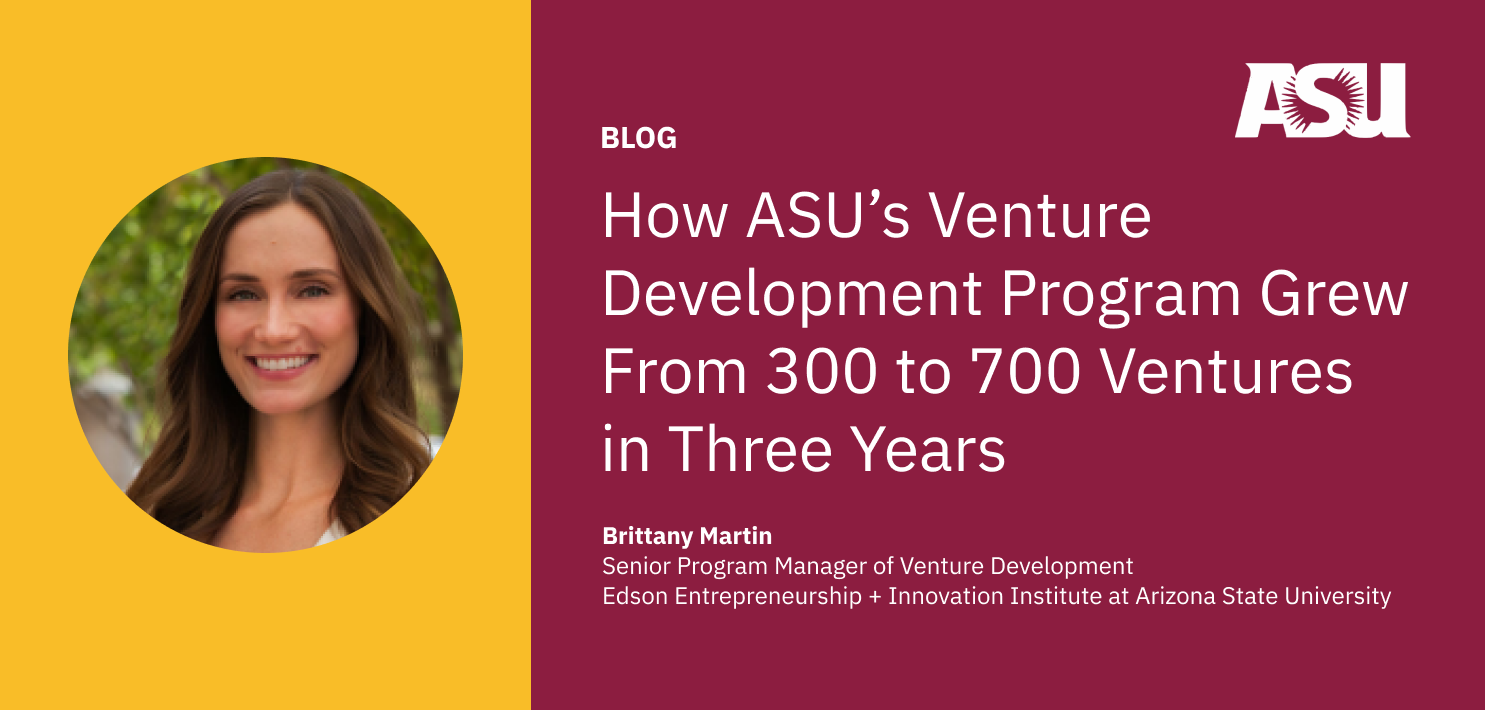
After our first installment of the entrepreneurial ecosystem builders series with Sam Wils at Columbia, I was on the hunt to learn more about the people behind the scenes making magic happen in university entrepreneurship and how they operate.

Brittany Martin is a Senior Program Manager of the Venture Development team at Arizona State University’s J. Orin Edson Entrepreneurship + Innovation Institute. She’s been in this role for three years and has been working in university entrepreneurship for six years now. Having been a StartupTree customer since her first year managing the Venture Devils’ bi-annual competition cycle, she has a lot of great insight to share about her experience.
She’s a life-long Sun Devil, having received both her Bachelor’s and Master’s at ASU and being a student-athlete on the diving team in undergrad. Maroon and gold all the way! She has a five year old daughter and will be getting married in December…a week after their upcoming Demo Day pitch competition!
Arizona State has over 700 ventures in their program and 40+ venture mentors — how do they organize all these moving parts and keep the ship running smoothly?
Arizona State has over 700 ventures in their program and 40+ venture mentors — how do they organize all these moving parts and keep the ship running smoothly?
This interview at a glance:
This interview at a glance:
- ASU E+I’s founding principle of making entrepreneurship accessible to all
- How mentorship helps ventures succeed
- Operations 101 for organizing judges for competitions
- Personal reflection on managing ventures and scaling impact in university entrepreneurship
------
Q: Tell me about Venture Devils and the mentorship-to-competition-to-launch pipeline for students interested in entrepreneurship at ASU.
Brittany: Venture Devils is starting our 6th full year of programming. It was founded on the principle that anyone can be an entrepreneur, and anyone at ASU should have access to support and resources. It’s comprised of a robust mentorship program, a bi-annual competition series, a collection of physical collaboration spaces, and access to external activities and networks that support entrepreneurs.
The threshold to get into Venture Devils is low because we want to ensure there’s no barrier to entry. Anytime an ASU-affiliated founder has an idea or has already launched an entity (can be ASU students, staff, faculty and alumni), we want them to apply to our program. We are continually trying to expand what we can offer entrepreneurs in their different verticals and industries, regardless of stage of development or entrepreneurial experience. We strategically make our program accessible, inclusive, and comprised of a diverse list of offerings so that we’re really meeting entrepreneurs where they’re at.
Our program will accept those that are just in the ideation phase all the way to those who are in revenue. Therefore, we need to have the capacity to support all sorts of founders. It’s a tall order, but we’re willing to do what we can to help them be successful.
Mentorship at ASU
Mentorship at ASU
Q: What have you found leads to the most success for applicants?
Brittany: Once they’re in the program, the thing we want them to focus most on initially is the mentorship component. We have such an incredible network of mentors and they do a fantastic job to make sure participants are headed in the right direction for traction and growth. Mentors share their own experiences (failures, successes, and everything in between) as well as those of current or past mentees.
We have a two-fold mentorship program: dedicated mentorship where each applicant is paired with one mentor specifically for them, and on demand/coaching that works in an office hours booking format. On demand/coaching is in beta testing right now during the summer months on StartupTree; we are excited to launch it more officially in the fall!
Inside Scoop on Judging at Competitions
Inside Scoop on Judging at Competitions
Q: What do you do behind the scenes from a judging and administrative standpoint?
Brittany: I handle all of the administrative and logistical tasks for our bi-annual competition cycle: getting evaluators and judges set up in StartupTree, providing a comprehensive training (including a StartupTree tutorial/walkthrough) is a part of that. I will say, competition set up and execution on StartupTree is user-friendly and quite intuitive, which has contributed greatly to running a seamless large-scale event. Typically, our judges will only use this platform a handful of times, so they aren’t lifetime or programmatic users. Even they appreciate how simple and straightforward the judging process is!
Outside of venture mentors, our competition evaluators and judges are E+I Staff, ASU Staff and Faculty, donors, key programmatic stakeholders and successful community entrepreneurs who are interested in engaging in the program. I’ll invite individuals that are interested in supporting the program from a donor/philanthropic standpoint, too. It gives them insider access to what the Venture Devils program is about, and how ASU and the E+I Institute support and celebrate entrepreneurship.
Q: How do you decide who evaluates what venture?
Brittany: Pitch Playoffs, the precursory competition is open to all founders in Venture Devils. Therefore, our evaluators are assessing a mix of all industries, verticals and stages of development. For that reason, I make sure that evaluators aren’t directly comparing one venture against the other, but rather, each venture’s readiness to compete for seed funding and preparedness to use that funding to support the traction of their venture.
Then for Demo Day, we call upon the donors and key funding stakeholders themselves and ask if they want to engage and participate in the judging process. Donors are often founders or executives of successful startups, companies, or corporations even, and they will call upon their own professional network to help with the judging process. Most often, the intent of these donors is to support young entrepreneurs as they were themselves- ‘paying it forward’ in a way.'
Q: How do you make sure you get the “right” judges?
Brittany: In addition to our donors and stakeholders, I have a whole listserv of individuals who have judged in the past and have been really high quality judges. Many of these people are ASU staff and faculty or community entrepreneurs that are looking to engage more closely with the ASU entrepreneurial ecosystem.
What I will say is that I always train the judges— not only on how to access StartupTree or the questions that they should be asking founders, but making sure that they really understand the objectives of our program and the ways in which ASU values entrepreneurship.
Demo Day isn’t supposed to be like Shark Tank. Many of our ventures are in ideation and prototyping, customer discovery and validation phases. These ventures are seeking that initial seed fund to get that jump start to really give them a true shot at success.
We ask our judges to be kind, courteous, but direct in providing their feedback. We want them to point out the positives but also offer insight as to what was missing from their pitch or their executive summary. This should be an encouraging experience for our founders. We want them to walk away with a clearer understanding of what it will take to get to the next level.
More on Understanding Impact
More on Understanding Impact
Q: How do you stay on top of connecting the dots between judges, applicants, mentors, and anyone else involved?
Brittany: A LOT of emailing! I have over the years, developed a set of very specific, detailed instructions, and created process documents.
Honestly, it’s a lot of one-on-one coaching since it’s predominantly student founders in our program. It’s also the most rewarding part — when you can develop those relationships and establish that rapport, when they’re coming to you with a need and you’re able to provide them with an opportunity, a connection, a resource, or a curated pathway to traction. That’s the best part of working in entrepreneurship.
Q: What is something surprising you’ve seen play out that you had to learn the hard way?
Brittany: The Venture Devils program grew from less than 300 ventures to 700 ventures in three years and we are still a (mighty) team of 3! Like with any startup, you need to learn how to grow and scale quickly and you need to learn how to do it the right way to make it work. Our team operates like a startup- lean and always evolving our process! Resource finding and sharing, developing curated programming and utilizing the expertise of our mentors are always constant objectives for our team.
Q: What is your biggest takeaway from that learning curve?
Brittany: Knowing when to ask for help. There’s a lot of parallels between what our team does and what we want to help others do. We know that sometimes we’ll fail and that’s okay because we’ll learn from it and fix it for next time — the pivot.
It’s not one specific thing per se, but a lot of little things, all related to scaling, growing, and leveling up: for ourselves, but for our ventures as well. It’s about making sure we’re always improving the opportunities and resources that we provide them with access to, ensuring there is always a true ‘value add.’
That’s something that weighs heavy on us because it’s a challenge, but we also feel really grateful to be in this position to be able to support and foster these innovative ideas. With over 700 ventures in the program, we know we are at least doing some things right. But we always want to do better, be better for the sake of our ventures and their development.
Using StartupTree really helps with that because everything’s in one place. Venture profiles, mentor profiles and scheduling capabilities, an events calendar and facilitating all of our applications and competitions in a single platform really helps to streamline our efforts.
Closing Thoughts
Closing Thoughts
Q: What’s one piece of advice you have for other university program managers?
Brittany: I don’t want to sound cliche, but I say this only because we have really explored many, if not all, of the functionality on StartupTree — if anyone feels like they could use something that’s very specific or unique to their program, they should not be afraid to reach out to you and your team. We’ve always experienced high quality customer service, and we do feel that you’ve made it a priority to understand our program and specific use-case for the platform.
---------
Click here to subscribe to our Insights Newsletter and stay in the loop on what other university entrepreneurship programs are up to!