

One of the first steps to building any startup is — say it with me! — to understand your customer. When running your entrepreneurship organization, why should it be any different?
The biggest key to having highly engaged students is getting a good understanding of 1. who they are and 2. what they are looking for.
Like with any product, you are not building it for yourself. Even if you are a user, you are not your market and you need to make sure what you’re providing fits with your market’s needs.
After directing a successful, entirely student-run university entrepreneurship program for over a year, I’ve learned that there are three main buckets of students involved in entrepreneurship with distinct needs and goals:
- Beginner Student: Beginners looking to dip their toe into entrepreneurship
- Mid-level Student: Student founders in the earlier stages of their entrepreneurial journeys
- Mega Student: Entrepreneurs further down the pipeline
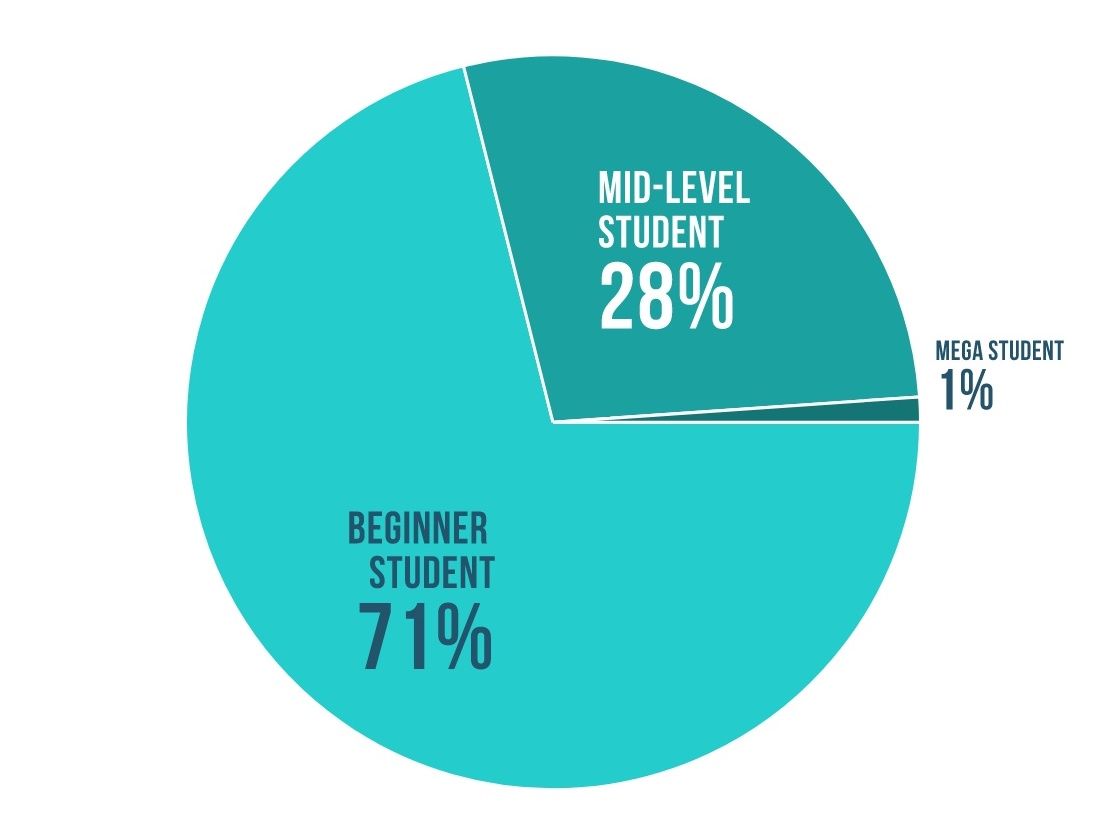
Taking a look at a breakdown of the 26k+ students currently on StartupTree, a very small percentage of students actually fall into the “Mega Student” category. Your goal should be to gain greater insight into the mindset of Beginner and Mid-Level Students and provide resources there first! Note: resources for both of these types of students definitely overlap and the segments may blur depending on how your university’s program is run.
1. Beginners looking to dip their toe into entrepreneurship
1. Beginners looking to dip their toe into entrepreneurship
This is the first tier of students in entrepreneurship and the broadest net to cast. Whether your goal is higher student attendance, higher retention, and higher overall involvement, putting some attention here is a surefire way to get more students into the pipeline.
Who are they?
- Students who are learning one facet of what it takes to build a startup in school — either the business side or some aspect of the product-building side, but not knowing how they can leverage all their skills to build a startup — and looking to break into the entrepreneurship space
- More often than not, freshman and sophomore year students, but students of all years should be considered in this bucket
- Students who may not yet have a fleshed out idea or feel like they know enough about the space, BUT are interested in learning more. They may say things like…
“I know I want to start a business one day, but I don’t feel like I have a winning idea or I don’t know how to act on it.”
“I don’t know if I want to be a founder, but the entrepreneurial mindset is fascinating to me and I want to explore where I can fit in.”
What are they looking for? How can you engage them?
Students in this category are trying to answer 2 main questions:
💡 Is entrepreneurship right for me? 💡 Do I have what it takes to be successful?
Help them answer that with…
Valuable Events + Programming
- Events (virtual or in-person) are a great, low-commitment way to involve new students and spark more continued involvement down the line!
- Get into the headspace of a student just getting started — what do they want to know? What do they want to learn? What do they want to do?
- An easy way to break down types of workshops is hard skills, soft skills, and introductions to career paths and emerging industries.
Here are some tried and proven ideas for valuable 1–1.5 hour workshop events:
- Hard Skills
- Design an App: Wireframing 101
- Coding in Python or Java
- Demystifying SEO in Marketing
- How to Build Your Own Website Using HTML + CSS
- Mastering the Art of Sales
- Soft Skills
- Develop Your Leadership Style
- Networking for Introverts
- Emotional Intelligence in the Workplace
- Intentionally Build Your Personal Brand
- Overcoming Imposter Syndrome
- Introduction to Career Paths + Emerging Industries
- Breaking into Emerging Industries: Cannabis, Micro-mobility (scooters, e-bikes), Fintech, AI, etc.
- Venture Capital for Dummies
- How To Get Started in Product Management
Community Connection
- Kickoff event — hosting a welcome event at the beginning of each semester is a great way to introduce students to everything your program has to offer, all while give them a chance to connect with other like-minded individuals
- Non entrepreneurship-focused community building events — especially during a fully or partially virtual semester, students breaking into any field are looking to answer the question “is this right for me?”
Similarly to how meeting real students from a college can be essential to helping a high school student decide if a college is right for them, meeting other students in entrepreneurship and getting to feel out the “vibe” in a low-commitment way can be perfect for these unsure students.
This can take on in the form of an icebreaker night, game night, ice cream run (in-person), holiday-centered community event, or any other type of group hang out. The focus here is on the people, with the activity as a guide.
- Virtual community — build a Slack for your community with intentional channels! It may take a while for this to take off and it certainly takes a small push from the admin side in the beginning, but it can be highly valuable in breeding more interactions and building a home-y network.
- This can also be a great way for individuals to connect after an event and keep the momentum going.
2. Student founders in the earlier stages of their entrepreneurial journey
2. Student founders in the earlier stages of their entrepreneurial journey
Who are they?
- Students who already have an idea and are working on it as a developing side project
- Individuals committed to the entrepreneurship space and looking for opportunities for growth
- Also includes founders a bit further down the line who are consistently working on their own startup, have built momentum, and have concrete milestones on the horizon
What are they looking for? How can you engage them?
Students in this category are trying to answer 2 main questions:
💡 How can I make sure my startup succeeds? 💡 How can I become a better entrepreneur and grow my startup?
Help them answer that with…
RESOURCES!
This right here is the bread and butter of any entrepreneurship program:
- Pitch competitions: the most tried-and-true opportunity for students to develop, iterate, and validate an idea with the incentive of funding
- Mentorship: there’s no need to reinvent the wheel; mentorship relationships can be incredibly valuable for both mentees and mentors
- Job opportunities: internships, fellowships, full-time positions, etc. are the best way for students to walk the walk; there is no better opportunity than hands-on experience
Students are looking to do a variety of things in this stage, so your best bet is to provide them with exactly what they’re looking for through your program.
- Information on funding options/opportunities: educating students on how to move forward with their idea
- Team member recruitment: ways for founders to get connected with the students with the skillsets they’re looking for and aligned passions
- Building an MVP: active office hours or connections to other students or experts who may be able to assist here
- Visibility for startups: a supportive and promotive entrepreneurial community goes a long way for startups just getting started; celebrate and increase visibility for any and all milestones
- Validation and constructive feedback every step along the way: keeping your founders on the right track from the start
The bottom line for this middle of the funnel is providing the dang resources that your students are looking for and making that process seamless.
“If you build it, they will come” does not necessarily apply here! Make sure these resources and opportunities are well-known and simple — or at the very least, not convoluted — to access. An all-in-one platform, like StartupTree, is a great way to easily manage all these facets.
3. Entrepreneurs further down the pipeline
3. Entrepreneurs further down the pipeline
Who are they?
- Founders and serial entrepreneurs involved in the pipeline who have gotten what they needed out of the resources in the last stage and are looking to get involved in other ways
What are they looking for? How can you engage them?
Founders in this category are not necessarily relying on an entrepreneurship org to answer any questions for them anymore. The questions to answer here are more personally focused.
💡 How can I utilize the entrepreneurial network and connections here? 💡 How can I play a bigger role and help others?
You can help them answer these questions with…
Opportunities to get involved from the other end
- Positions in the organization itself: This is a big one! Depending on how your organization is structured, this could mean opening positions for student interns or more student board positions for student-run entrepreneurship organizations.
- Mentorship opportunities from the mentor side: Founders or students in this category may be looking more to start giving back to the community and help others going through what they’ve already gone through — time to share wisdom with the right people.
- A strong, valuable network: All the other steps you’ve taken to engage your students up to this point should point to having an entrepreneurial ecosystem that student and alums keep coming back to. A strong network made of engaged members builds a culture that is self-sufficient enough to continue running purely on the relationships that have been created through initial engagement.
Final Thoughts
Final Thoughts
At the end of the day, students WANT to be engaged. They are at your college or university for a reason: to find their passion, their purpose, or at the very least, a group of supportive friends, peers, and mentors to figure that out with.
Creating truly valuable engagement in a community is a two-way street; jumpstarting that excitement and interest will quickly multiply into new ideas, evolving needs, and sincere value.
“We must remember that our students are innately creative, innovative, and collaborative, and that we suppress these things with our control. Empowerment is the key that will unlock them.” — Kevin Parr, Association for Supervision and Curriculum Development (ASCD)