At StartupTree, we're dedicated to keeping you up-to-date on what's happening in the entrepreneurship community right now.
Each month, we host our Collective Minds community meet-up -- a place for directors, program managers, and other operators of entrepreneurship to gather and discuss challenges and best practices. The Rundown continues to be an easy way to gain quick access to the discussion in these meetings!
💡 Breakdown of what entrepreneurship directors are talking about this month: 1. Competition logistics best practices 2. Integrating your competitions with the larger entrepreneurial ecosystem
_____________
Best Practices for Hosting a Competition
Best Practices for Hosting a Competition
Whether your entrepreneurial organization hosts one or ten competitions throughout the year, there are a few key factors that can transform these events from good to unforgettable, all while reducing stress and uncertainty for your team.
In this edition of The Rundown, we will cover:
- Successful ways to encourage participation
- Ensuring participants are diverse and interdisciplinary
- Effectively managing judges
- Running a great show
- Keep participants engaged in your community

_____________
Successful Ways to Encourage Participation
Successful Ways to Encourage Participation
A competition is nothing without a committed pool of participants who are hoping to make the best of the opportunity you are providing them.
Unique Strategies to Gain New Participants
Unique Strategies to Gain New Participants
Beyond your typical marketing channels (such as social media posts, newsletter announcements, and flyers), these are the top unique ways to encourage new participation:
- Leverage LinkedIn
LinkedIn is becoming an increasing useful tool for forming professional connections and building on one’s career goals. This platform is key to finding not only people that are interested in you, but people you are interested in as well.
💡 Create a LinkedIn post about your opportunity and share it with as many people as you can. Have other organizations repost it and broaden your reach.
💡 Take advantage of direct messaging and LinkedIn’s search tools to find participants that you think would be a great fit for your competition.
- Promote student referrals
Student referral programs are an effective way to recruit within a university. Students highly value the word of their peers so having these folks on your team will be invaluable.
💡This could be a paid opportunity, but preferably it is a volunteer one where the students who have been influenced the most by their learnings from your competition come to give back to the program.
- Get alumni to recruit participants
Alumni are a great resource that organizations rarely think to leverage when recruiting new participants for their competitions. Hearing about the great success stories that have come out of your program, especially those that have occurred in the near past, make achieving success feel much more tangible for participants.
💡 Have program alumni recount their experiences with your competition and how it has helped them grow personally and professionally at the very first meeting.
- Find professors to advertise
University professors can be a useful tool during the participant outreach process because they have influence over a countless number of students each day. If they say something is worth doing, their students WILL listen. Form a lasting relationship with professors in different fields at a university and get them invested in your program’s mission.
💡 Share resources, deadlines, and upcoming events with them that they can pass along to their students.
💡 Come in to their classes and pitch your opportunity to their students in person.
- Organize a funnel
Use any other programming within your organization or in adjacent organizations to help build a funnel of participants that see joining your competition as the “next step” in their entrepreneurial journey.
💡 Leave your first few educational bootcamps open to anyone so that people can dip their toe into the program without feeling like they are fully committing.
💡 Have other programs promote your competition as the next thing their participants should take advantage of.
Find a funnel that works best for you and do not limit yourself to just one. There should be several funnels that all point your way so you can maintain the most diverse outreach possible.
Participant Outreach Timeline
Participant Outreach Timeline
How soon you reach out to new participants depends on whether you host one or multiple competitions, how spread out your competitions are year to year, and where you recruit participants from.
If you gain participants from a university:
Start your recruitment from day one of the new school year. Kicking off each semester, there are typically tons of events where students are looking for exciting opportunities to commit to for the next few months.
If you gain participants from outside a university:
Be sure to leave yourself enough time to generate interest, weed through candidate profiles, and have at least the first few bootcamps of your upcoming programming set by the time participants are finalized.
Depending on your efficiency and how competitive your program is, this could be as little as two weeks and as far out as a year.
_____________
Ensuring Participants are Diverse and Interdisciplinary
Ensuring Participants are Diverse and Interdisciplinary
To make your competition as successful as can be, you want to gain a cohort of participants that can bring different and interesting things to the table. The only way to achieve this is by ensuring that your participants are both diverse (based on gender, race, socioeconomic class, etc.) and interdisciplinary.

1. Partner With Other Nearby Universities
1. Partner With Other Nearby Universities
💡 If you’re outside of an institution, consider working directly with surrounding universities to gain the benefit of their deliberately diversified community. Be certain you set boundaries early on for how much involvement you want from them.
2. Leverage Professors
2. Leverage Professors
💡 Professors across different disciplines at the institution can be a great resource to encourage students of different majors and backgrounds to join the program.
3. Integrate Into A Curriculum
3. Integrate Into A Curriculum
💡 Making a competition a mandatory part of a class (especially an entrepreneurship elective) is a great way to ensure participation from a diverse set of applicants.
4. Create Teams
4. Create Teams
💡 Encouraging (or even requiring) people work in teams in your competition will not only increase the age and gender diversity, but decreases the participant dropout rate.
5. Offer Grants
5. Offer Grants
💡 Host a grant for students from low-income zipcodes to encourage them to join. This could be funded by your organization, a university, or even your state.
_____________
Effectively Managing Judges
Effectively Managing Judges
Judges for a competition, whether internal or external to your community, must have a clear understanding of how they will be evaluating students during your competition. Judges could be community members, alumni, faculty, leaders within your organization, or even other students participating at the competition (providing feedback to each other).
Because of the diversity of backgrounds that judges bring to the table, it is essential that you train your judges beforehand. This means making sure everyone is on the same page on logistics, rating systems, and who participants will be.

Set Explicit Criteria
Set Explicit Criteria
- Set criteria very explicitly and share that rubric with both judges and participants.
- Be aligned with what the judges, participants, and potential investors are looking for.
- Make sure your judges are prepared to make judgements based on the specific stage of ventures in the competition you're hosting, whether it's an ideas competition or a funding stage pitch.
- One example would be make the leading criterion be "how would you actually spend the money if you won."
- Allow judges time to align on their final decision after the pitches are done
- It is always hard to judge the first team accurately because they are not too sure what they are scoring against.
On Giving Feedback
On Giving Feedback
- Record qualitative comments to share with students
- Any quantitative data is also helpful, but not as necessary
- Set up the system to make sure you can easily transfer their feedback to participants
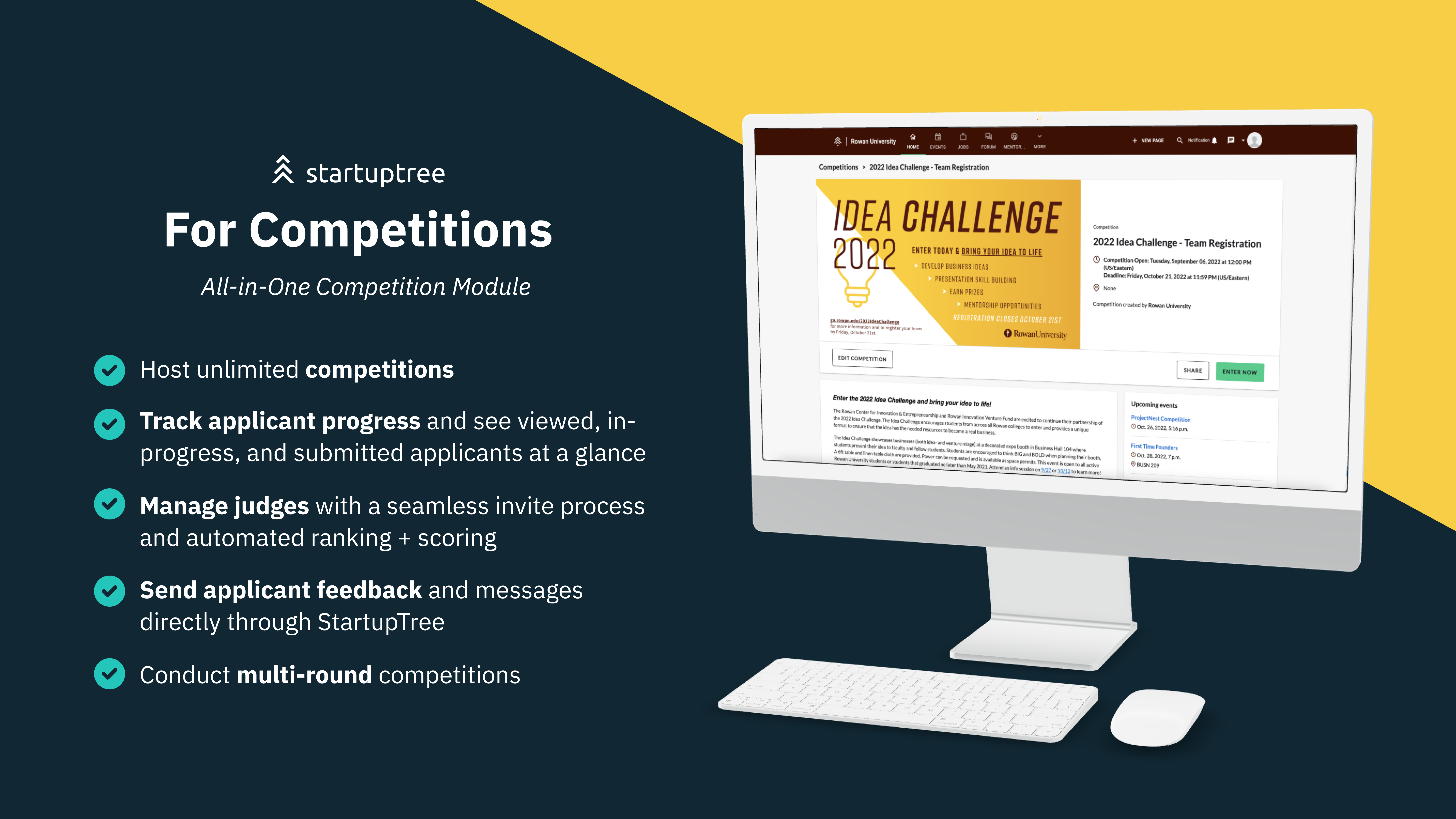
💡 On the StartupTree platform, you are able to segment internal-facing feedback and venture-facing feedback so that judges can be honest when making comments to help them deliberate, while also providing participants with useful feedback. Administrators can then send venture-facing feedback to the participants directly through their platform!
_____________
Running A Great Show
Running A Great Show
At our webinar Entrepreneurial Ecosystems: How to Diversify Competition Applicants & Engage Judges, Jessica Vattima, Assistant Director at Rowan University, talks through her process for planning a successful competition. Watch the webinar on-demand to learn more.
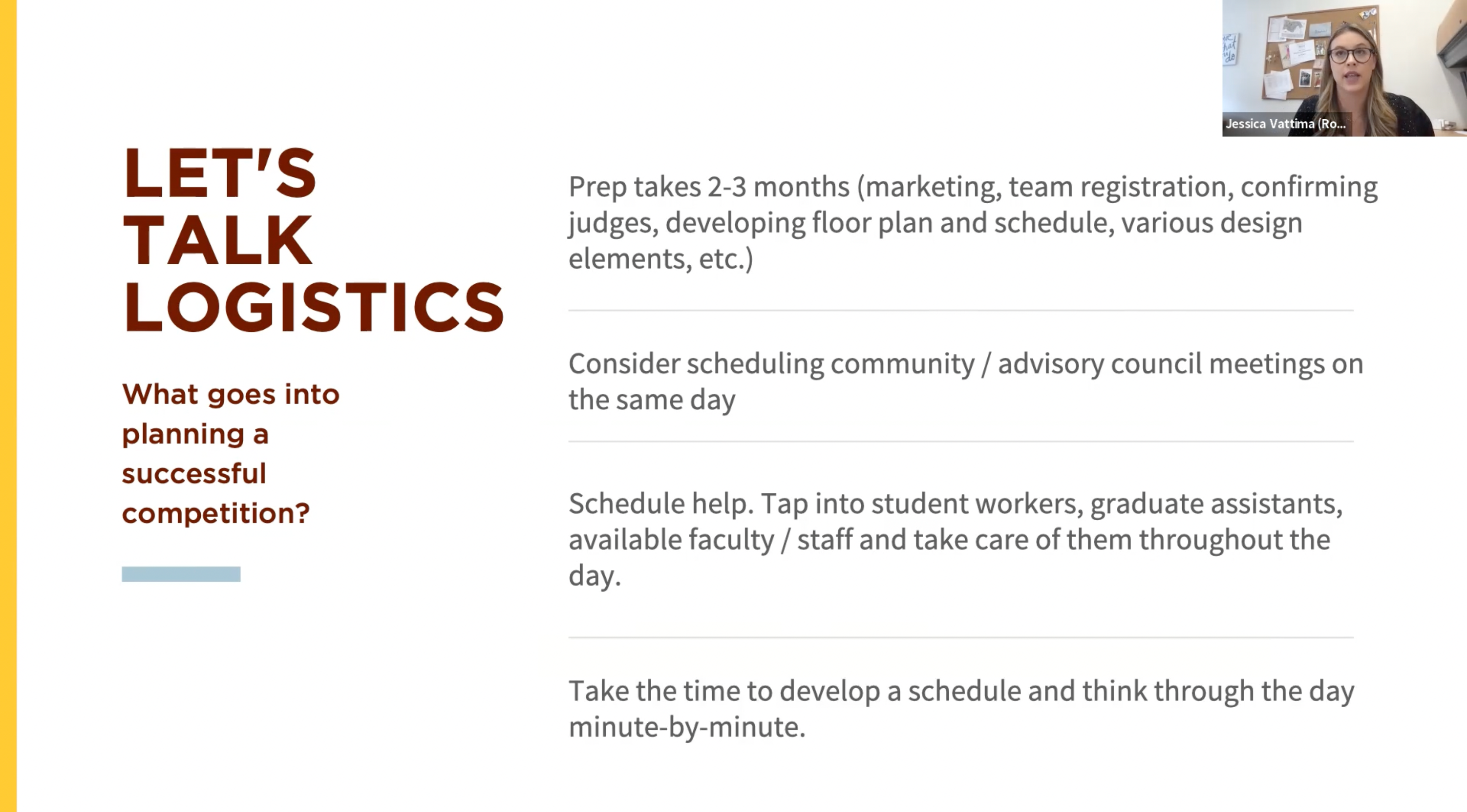
💡 Competition Planning Tip #1 from Jessica: Schedule your competitions on the same day as your advisory council meetings. It makes it easier for stakeholders and board members to say "yes" to participate since they will already be there.
💡 Competition Planning Tip #2 from Jessica: Take care of your team! Look for student workers with a can-do attitude, assign them meaningful tasks that you yourself would not mind doing, and make sure to thank them for their time, energy, and helping hands.
💡 Competition Planning Tip #3 from Jessica: Make time to develop a schedule and plan out the day minute by minute. Plan for the what if's and worst case scenarios. Be able to anticipate fires and not get caught off guard without a plan of action.
All entrepreneurship competitions share key qualities and audiences. With the right plan in place, your competition can be enhanced from a local event to an illustrious show. Some suggestions:
- A generally recommended structure for an ideas competition is a 5 to 10-minute pitch with 2-5 mins of questions from judges. Launch stage competitions will likely have longer pitches.
- Be mindful of the time and include any potential issues (faulty tech, people speaking over time) in your plan.
- A weighting scoring rubric can help judges automatically prioritize certain features over another
- Host a rehearsal for participants and have a backup plan for everything that could go wrong during the final show (e.g. technical difficulties, missing presenters)
- Have two aligned schedules, one for front-stage and one for backstage, can help things run more smoothly. Call names for the next presenters to be ready up to 10 minutes early in the back of stage.
_____________
If your program is looking for a platform solution to help you manage the chaos of competition management, an all-in-one competition management platform like StartupTree could be the answer!
_____________
Keep Participants Engaged In Your Community
Keep Participants Engaged In Your Community
If you run additional programming within your organization, the competition’s Demo Day should NOT be the last you see of these participants. Ideally, you want to keep participants engaged in your community even after the competition ends.
Ways To Maintain Engagement
Ways To Maintain Engagement
- Refer them to resources that can be helpful to launch them into the next stage of their journey
- E.g. other competitions, accelerator programs, funding opportunities
- Invite them to be champions of your community and get new people to join next time
- E.g. through student referrals program, as an alumni speaker
- Invite them to be mentors for the next round of participants
- Be selective and pick the right participants for this type of opportunity
- Encourage them to participate in other events within your general entrepreneurial community
- Highlight the unique benefits they will gain at their stage
_____________
And that's a wrap for October! Browse through StartupTree's on-demand webinars page for more in-depth resources on competition management, including:
- Start to Finish: How to Organize a Startup Pitch Competition with Tufts University
- Competitions 2.0: How to Successfully Manage Coaches, Judges, + Metrics with Bowie State University