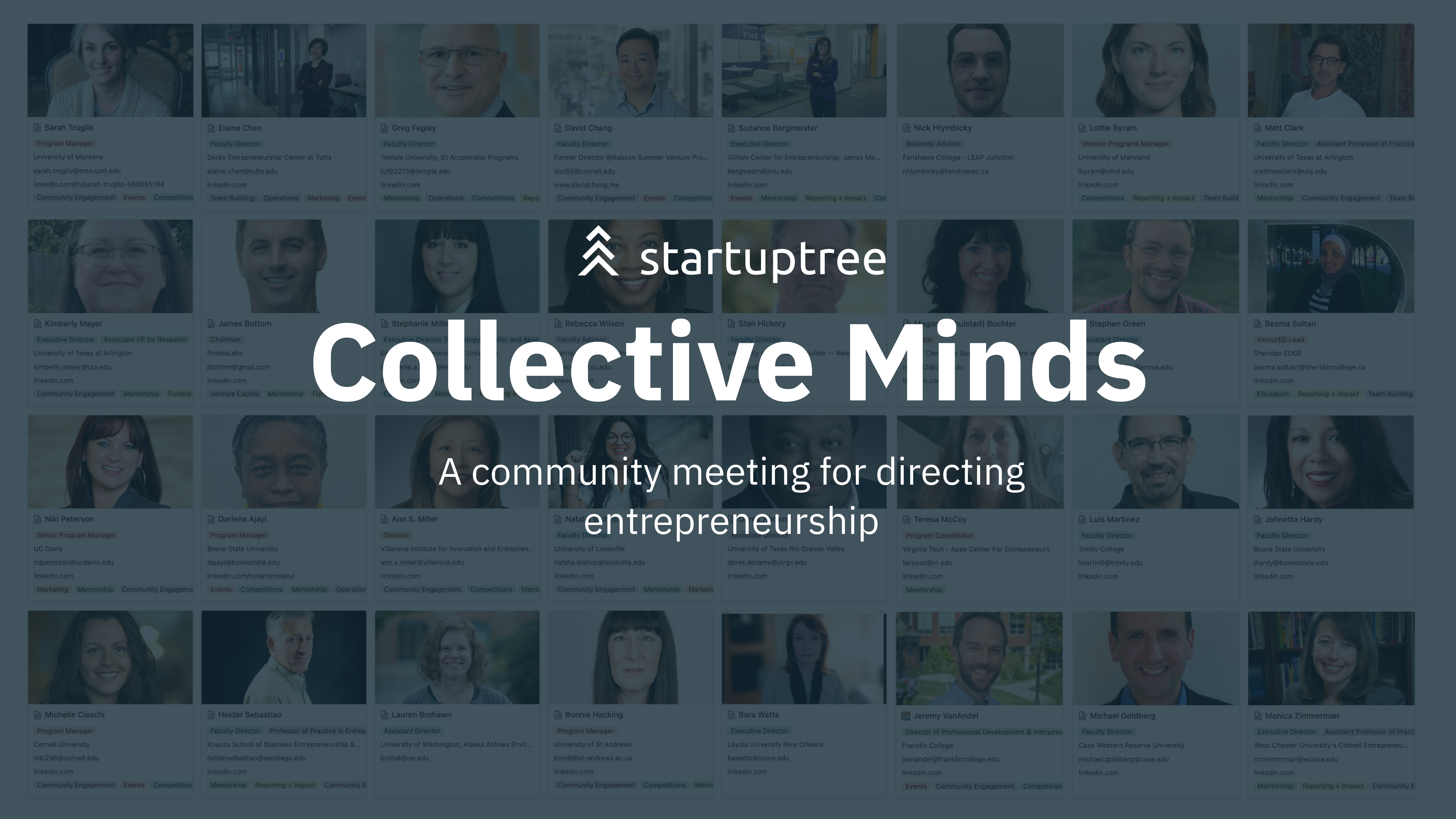
Introducing StartupTree's official rundown on what the entrepreneurship directing community is talking about this month:
For 7 months now, we’ve been gathering an active community of directors and operators of entrepreneurship from all around the world to come together and discuss challenges, share best practices, and celebrate wins together. We’ll be sharing some of the top takeaways from July’s discussion.
At organizations big and small, new and experienced, topics that came up repeatedly include:
- The state of remote/hybrid programming
- Predictions for how the landscape of student engagement will evolve
- Challenges and solutions to engaging mentors
- Staffing changes and onboarding new team members
_________________
Student Engagement
Student Engagement
Student burnout has become a pressing issue, especially when it comes to encouraging students to attend extracurricular activites on top of classes. Virtually all of StartupTree’s community members have noticed it to an increasing effect with their students.
Challenges
Challenges
- Elaine Chen, the Director of the Derby Entrepreneurship Center at Tufts University, noticed that there has been a considerable decline in the number of students actively participating in entrepreneurship programming. Students seem to be checking out after their last final, and reaching the point of fatigue and burnout at a much faster and deeper rate than before COVID.
- In addition to running their summer startup accelerator fully hybrid, Tufts plans on doing full hybrid everywhere in the upcoming year, from teaching in the classroom to workshops to competitions.
- Sarah Truglio, Blackstone Launchpad Manager at the University of Montana, added that gaining attendance, specifically during the summer, has been challenging.
- Nazar Tkachenko, from the Veale Institute for Entrepreneurship at Case Western Reserve University, agreed that it has been a challenge to keep students engaged in the summer months.
- One issue with virtual events is that there is no physical incentive directors can use to encourage event attendance. Food and cocktails have always been key to encouraging a large turnout, so when COVID switched everything to virtual programming, many centers felt the hit.
Solutions
Solutions
- In an attempt to help with student engagement, Elaine (Tufts) noted that moving to fewer and larger events, instead of smaller and more frequent events, may help with student turnout. Tufts is planning on doing as many in-person events as possible with food and drinks as incentives to go, but when virtual is the only option, giving away inexpensive swag also helps with turnout.
- Clare Harwood, New Ventures Analyst at Texas A&M, mentioned that the combination of food, football, and alcohol never fails to set up a good environment for networking, a sentiment that strongly resonated with many other members.
- To help with student engagement, Nazar voiced that Case Western is going to proactively target the incoming freshmen this year, who will be expecting a more normal college experience and who have not yet experienced COVID burnout while in college.
- To do this, there will be many activity fairs, student activities, and entrepreneurship clubs available to the incoming students this fall, as well as plenty of activity on social media (Instagram and TikTok).
- Sarah also suggested that holding introductory sessions where students can learn about their program has been particularly successful at the University of Montana.
Mentorship Programs
Mentorship Programs
Mentorship is one of the most important opportunities to take advantage of throughout a founder’s journey, and an increased utilization of mentorship was one of the top priorities for many entrepreneurship centers for this upcoming school year (42% of our community members say this is the top priority for them in the fall semester).
- At many schools, mentoring is now conducted in a hybrid, or even fully remote fashion. Louis Goldish, Senior Advisor at MIT Venture Mentoring Service, expressed concern about a loss of camaraderie among mentors who now cannot meet each other in person, let alone with students.
- They used to hold monthly in-person mentor meetings, and have found that they are simply not as impactful for community-building purposes when conducted remotely.
- As a solution, it can be set up that mentors and students have their first meeting in-person, with the option of having sequential meetings either in-person OR virtual. Peter Apicella, Director at the Center for Entrepreneurship at Lake Erie College, expressed similar concerns about mentorship engagement in an ecosystem setting.
- One advantage of having the option for remote mentorship, according to Louis (MIT), is that since alumni (who often volunteer as mentors) move all around the world after graduation, the disappearance of geographic barriers allows students to meet with a greater pool of quality alumni and mentors who may live outside their region.
- Chris Scotti, Director of New Ventures at Texas A&M, predicts that the hybridization of virtual and in-person programming will allow for further extra-regional engagement of alumni investors and mentors.
Staffing Challenges
Staffing Challenges
The switch to a hybridization of work and the Great Resignation has made many people reconsider their career paths.
- In a conversation among Chris Scotti (Texas A&M), Allen Chen (Program Manager of Eugene M. Lang Entrepreneurship Center at Columbia Business School), Marcos Hashimoto (Director of Turner School of Entrepreneurship and Innovation at Bradley University), and Greg Fegly (Director of the IEI Accelerator Program at Temple University), they discussed how hiring student interns to assist with managing StartupTree and other aspects of programming can be a good way to deal with staffing shortages.
- Elaine (Tufts) raised the point that lots of professionals have either changed jobs or been relocated over the past two, unpredictable years, which has caused a shortage of staff for their program. On top of people leaving, it is difficult to find new people to replace the lost ones with the right training and timing to line up with their programming schedule.
- Since hybrid systems are still relatively new, funding and budgeting can also be real challenges. Sarah (University of Montana) emphasized that the lack of funding she has faced has impacted the ability to get a full staff willing to work with a hybrid system.
- Louis (MIT) also brought up the point that most of the staff in his program are volunteers, so with hybrid work, it is difficult to keep volunteers engaged.
- Case Western Reserve University’s team, including Stacy Lotz (Assistant Director) and Nazar Tkachenko, is in the process of balancing onboarding many new staff roles at their center, while simultaneously preparing fall programming for their students.
Competitions
Competitions
Live competitions are rather difficult to run in a hybrid format. With an anticipated increase of in-person activity, one of the top priorities for many entrepreneurship centers is to level up their competition and application participation.
- Allen Chen (Columbia Business School) is aiming this year to ramp up their competitions, as well as amplify alumni accomplishments and hold more high profile competitions and events.
- One of Francisca Reyes’, Entrepreneur-in-Residence at Blackstone Launchpad at University of California, Riverside, goals for this upcoming year is to increase the number of students from more schools outside the business school to participate in competitions.
In summary…
In summary…
Without an in-person sense of community at the forefront of entrepreneurship programming, it has been challenging for new and experienced programs alike to engage students in the same capacity as before COVID.
Is this something that will permanently change the landscape of participation in college extracurriculars?
Creating an in-person sense of community is a top priority for our community, and this fall semester will be the ultimate test.